
Teatro Amazonas, home of the Festival Amazonas de Ópera
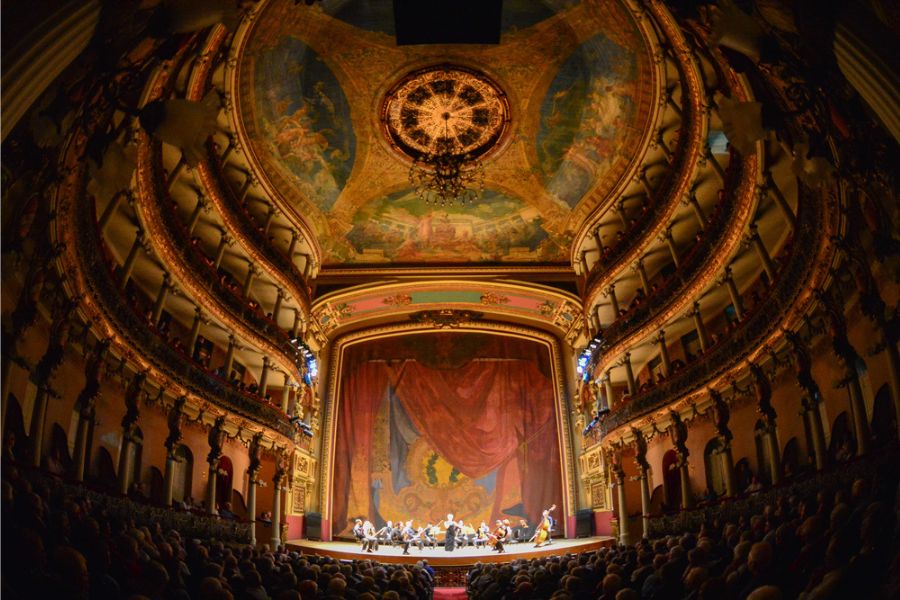
Founded in 1997, the Festival Amazonas de Ópera is a prestigious event that has, from its very beginnings, committed to programming operas from the traditional repertoire alongside contemporary titles. The Teatro Amazonas in Manaos has been, since its last restoration, the venue that hosts the festival. In this new edition of Theatre of the Month, we tell its story.
At the opening of Fitzcarraldo (1982), directed by German filmmaker Werner Herzog, the Teatro Amazonas in Manaos makes a starring appearance. The character of Brian Sweeney Fitzgerald — known as Fitzcarraldo —, an eccentric Irish adventurer and trader obsessed with opera, approaches the theatre, eager to hear the tenor Enrico Caruso sing in Verdi’s Ernani.
“We come from Iquitos, 1,200 miles upriver. I had to row because my boat’s engine broke down […] For two days and two nights I have rowed to see Caruso at least once in my life,” says Fitzcarraldo, played in the film by Klaus Kinski. Before him rises the façade of the Teatro Amazonas, characterised by a rounded pediment with reliefs adorning its surface and rows of columns on three floors supporting the entire structure.
Fitzcarraldo’s encounter with the Teatro Amazonas illustrates the determination with which audiences once flocked — and still do — to this opera house. The scene also shows how the building became one of the most important historical landmarks — and a current tourist and cultural attraction — of Manaos, a city set in the heart of the Amazon that flourished thanks to the rubber industry during the nineteenth century and became the “Paris of the Jungle”, an emblem of the Brazilian belle époque.
Manaos, the “Paris of the Jungle”
The Teatro Amazonas stands facing the Plaza San Sebastián, beside the parish church honouring that saint, in the very heart of Manaos. With a seating capacity of 701, it is home to the Orquestra Filarmônica do Amazonas and serves each year as the venue for the Festival Amazonas de Ópera — the main lyric event of the regional state, which makes Manaos the epicentre of opera in Brazil.
The history of the Teatro Amazonas runs hand in hand with the history of Manaos. In the seventeenth century, Portuguese colonisers founded the Fort of São José do Rio Negro. This rural outpost was a strategic point for the Portuguese Empire, situated at the confluence of the Rio Negro and the Amazon.
Following Brazilian independence in 1822, the captaincy of São José do Rio Negro was granted the status of a town and, in 1848, was renamed Manaos — a tribute to the Manaós tribe, the original inhabitants of the region. Between 1890 and 1910, the city became the centre of the rubber boom, a social, economic and cultural phenomenon that drew waves of Brazilian, French, Italian and British migration, among others, and triggered an explosive surge in wealth.
Manaos became a hub of imposing and lavish buildings, parks, plazas, gardens with fountains and statues, granite pavements and lioz stone imported from Portugal. Eduardo Ribeiro, the charismatic regional governor of the time, ensured that all urban reforms and planning met the standards of modernity that the wealth accumulated during the rubber boom could afford.
A belle époque aura hung over the opulence that the bustling Amazonian bourgeois society demanded for itself. A building devoted to the enjoyment of culture and opera became a necessity. To cement his legacy, Ribeiro committed to completing the construction of the Teatro Amazonas, which had begun in 1884 under the direction of Italian architect Celestial Sacardim.
“I began with a village and turned it into a modern city,” were Ribeiro’s words as he established himself as an icon of the modernising aspirations that, at the turn of the century, characterised different Latin American nations. His tenure as governor, however, came to an end before the theatre’s lavish opening.
A witness to Manaos’s golden age
After nearly twenty years under construction, the Teatro Amazonas finally opened its doors to opera. On the evening of 7 January 1897, an eager crowd gathered for a performance of La Gioconda by Amilcare Ponchielli.
The theatre itself was also a spectacle. For its construction and ornamentation, Italian Carrara marble was imported for the columns, staircases and statues; steel from the foundries of Glasgow supported the walls; and materials for the roof arrived from Alsace.
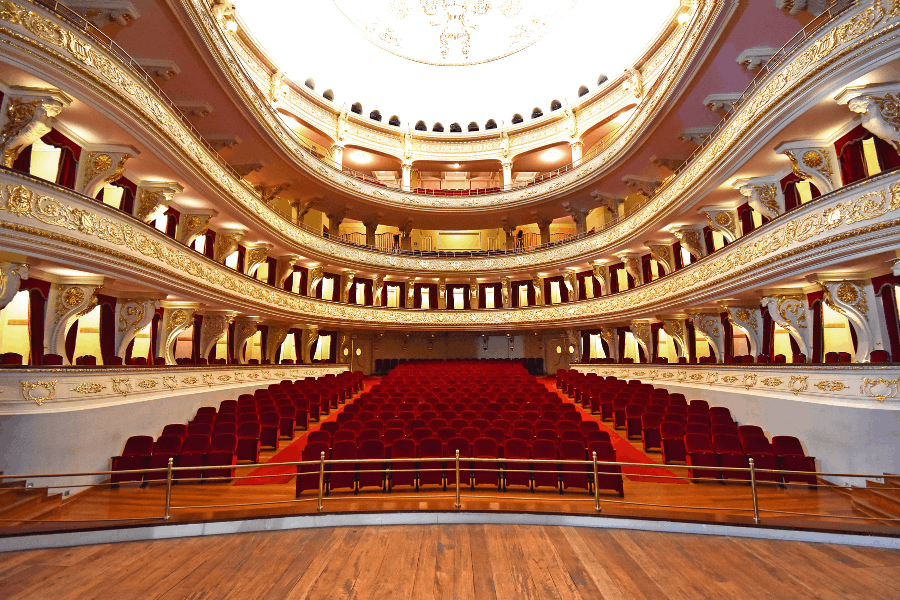
Inside, the furnishings brought from Paris in the “Louis XV” style stand out, as do the fresco paintings by Domenico de Angelis that run along the walls, and the stage curtain by Crispim do Amaral, entitled The Meeting of the Waters, which depicts the confluence of the Rio Negro and the Solimões. On the columns surrounding the audience are masks honouring composers and playwrights from throughout history, including Aristophanes, Molière, Mozart, Rossini and Verdi.
The theatre also met the most modern standards of its era. “Each of the six hundred seats had its own ventilation system to overcome the humidity and heat — though this was not enough to persuade Enrico Caruso to travel there for the inauguration,” notes journalist Jorge Álvarez in an article for the cultural magazine La brújula verde on the history of the theatre.
In its early years, the Teatro Amazonas attracted various Italian and French opera companies, giving Manaos an important status as a cultural reference in Brazil and Latin America. The city’s splendour, however, was not to last; by the mid-twentieth century, the rubber industry had shifted to Asia, where lower costs and greater extraction efficiency made it more competitive.
Manaos entered a period of economic decline: investment fell, much of its population moved elsewhere in search of work, luxury imports came to an abrupt halt, and urban decay left many of the opulent buildings abandoned. The Teatro Amazonas was no exception; for all that its brilliant periods had elevated it as a magnificent opera house, years of abandonment had also left it adrift — a witness to the golden age of Manaos.
The Festival Amazonas de Ópera
After being restored on three occasions — in 1929, 1974, and between 1989 and 1990 — the Teatro Amazonas once again became a home for artistic performances in the early 2000s under the governorship of Amazonino Mendes. Today, the theatre is home to several resident ensembles: the Orquestra Filarmônica Amazônica, the Coral Amazônico, the Corpo de Balé Amazônico, the Orquestra de Câmara Amazônica, the Orquestra de Guitarras Amazônicas, the Banda Amazonas and the Ballet Folclórico Amazônico.
The Festival Amazonas de Ópera (FAO), meanwhile, found in the Teatro Amazonas a new home for both national and international opera productions. Founded in 1997, the festival was the first of its kind in Latin America and a major reference point for Ibero-America.
As well as staging traditional operas such as Madame Butterfly, Dialogues of the Carmelites, La Traviata and Carmen, and achieving the feat — unique in Brazil — of presenting Wagner’s complete Ring Cycle, the event has committed to an ambitious renewal of its repertoire: it has programmed titles such as Lulu by Alban Berg, Magdalena by Heitor Villa-Lobos, Ça Ira by former Pink Floyd frontman Roger Waters, and, more recently, O corvo and Moto-contínuo, which establish a dialogue between media arts and opera.
Under the direction of Flávia Furtado, the Festival Amazonas de Ópera has welcomed more than 4,000 artists and technicians and drawn more than 370,000 audience members across its various editions, held each year between April and May. At the festival’s 24th edition, held in April and May 2022, the principal conductor of the Coral Amazônico, Otávio Simões, noted that “the audience can expect diversity as always, wide-ranging and ambitious themes. The FAO will always present different subjects for different kinds of groups, for all ages — everyone can come and see the Festival Amazonas de Ópera.”
The Teatro Amazonas was born and came of age in a period of opulence and prosperity. It was abandoned in times of crisis and economic despondency. Cinema — through Werner Herzog — revalued it and brought it to new audiences in the 1980s, and ultimately the space found its rebirth. Today, the Teatro Amazonas is not merely a witness or relic of a golden age, but a living building that fuses the historic with the modern — and one that, once a year, becomes the stage for an opera festival that draws the attention of the entire world.