
Gran Teatro Nacional: a modern home for the arts and cultures of Peru
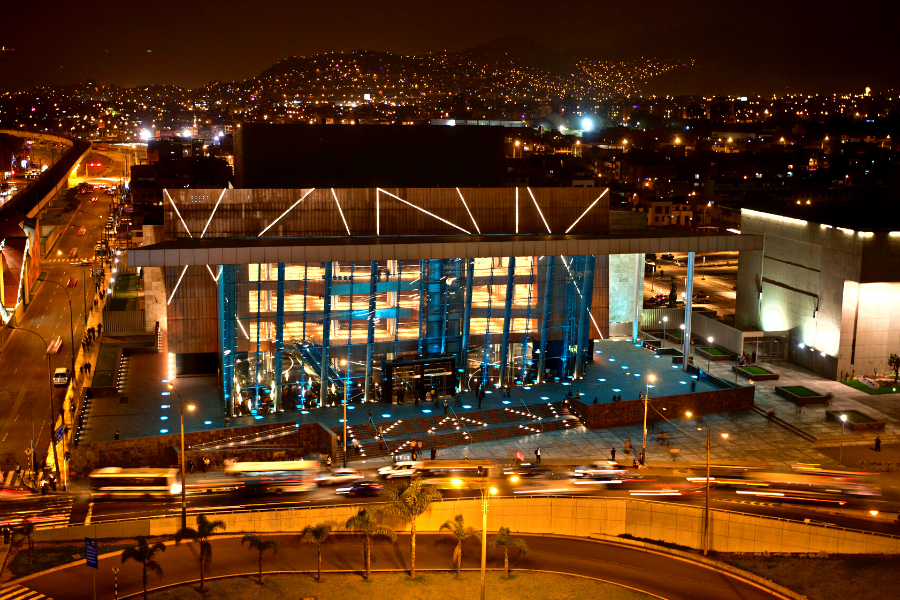
Peru’s Gran Teatro Nacional was inaugurated on the evening of 22 July 2011 with a ceremony featuring the Orquesta Sinfónica Nacional del Perú, Canadian soprano Erin Wall and Italian bass-baritone Ruggero Raimondi. In 2012, it opened its doors to the public for the first time with an opera-ballet created specially for the occasion, composed by Peruvian Nilo Velarde, and a recital by Spanish tenor Plácido Domingo. The largest theatre in Peru, located in the Lima district of San Borja, it represents the country’s commitment to the arts, with a focus on serving as an international platform for Peruvian talent and staging world-class productions. Its primary purpose, however, is to encourage the engagement and participation of Peruvian citizens in the performing arts.
On the evening of 22 July 2011, a long-held aspiration of Peru’s artistic and cultural world was finally realised. After two years of construction, the Gran Teatro Nacional (GTN) — the country’s largest and most modern performance venue — was officially opened. “This is a singular evening of joy, as we hand over to the nation this marvellous work through which our country joins the world stage of dramatic art, lyric theatre and dance,” remarked Peru’s then president, Alan García.
The opening ceremony offered a foretaste of the Gran Teatro Nacional’s mission. The concert began with a performance by Otoniel Ccayanchira, an Ayacucho-born harpist, who played the piece Valicha alongside the Orquesta Sinfónica Nacional, under the direction of Miguel Harth-Bedoya.
Yet it was not only national talent that took to the stage that evening. As international guests, Canadian soprano Erin Wall (1975–2020) — associated with the Metropolitan Opera, La Scala and the Opéra de Paris — and the legendary Italian bass-baritone Ruggero Raimondi (1941), a star of opera houses and film screens worldwide, also performed. The Gran Teatro Nacional was launching its story with ambitions to match.
Modernity and innovation
The district of San Borja lies to the east of Lima. Its streets reflect facets of the country’s history, with urban, residential and cultural life animated by landmarks such as the Torre del Banco de la Nación, the Centro de Convenciones de Lima and the archaeological complexes of Huaca San Borja and Limatambo, set against a backdrop of architecturally adventurous residential buildings.
San Borja was chosen as the location for the Centro Cultural de la Nación, which houses the Biblioteca Nacional del Perú, the Museo de la Nación, the Ministerio de Cultura, the Ministerio de Educación and, as its centrepiece, the Gran Teatro Nacional del Perú.
The initial concept for the Gran Teatro Nacional dates to the early 2000s, when the need for a modern, large-scale venue capable of hosting both local and international productions was first identified.
The urban development of San Borja — and of other Lima districts such as La Victoria — also reflects an ethos of innovation that the city has committed to fostering. In 2010, architect Augusto Ortiz de Zevallos observed, in reference to the emergence of cutting-edge architecture across the capital, that “something new is now being invented, as happens in all great cities, driven by a young population reimagining its city.”
In 2007, the Patronato del Teatro Nacional was established — described by the theatre as “a group of private benefactors seeking to promote the creation of a modern, technologically advanced venue for the country’s performing arts.”
Defining the construction required an open competitive tender. Peruvian architect Alfonso de la Piedra’s firm was responsible for the overall structure, while acoustic design was carried out by Brazilian expert José Nepomuceno, who has also worked on spaces such as the Sala São Paulo, the Auditório Ibirapuera and the Theatro Municipal de São Paulo.
The main construction work took place between 2010 and 2011. The theatre occupies 15,000 square metres at the corner of Avenida Javier Prado Este and Avenida Aviación. Its design draws on a futurist and distinctly contemporary architectural language intended to reflect Peru’s twenty-first-century vision. The building accommodates 1,500 people, a fully equipped stage, rehearsal and support rooms, and a range of specialist artistic spaces.
According to Nepomuceno, “acoustics drove the design, from the shape of the room to its volume, from the choice of materials to the selection of seating. The acoustic consultants adopted a modified horseshoe plan to improve intimacy and sound levels across three tiers. The hall has two reverberation chambers and several acoustic banners to provide variability in the room’s acoustic response.”
Between local tradition and international reach
Following the inauguration, the theatre opened to the general public on 12 July 2012. The Gran Teatro Nacional’s first season made an immediate statement: it opened with Akas Käs, La promesa del guerrero, an opera-ballet created specially for the occasion by Peruvian composer Nilo Velarde and choreographer Celeste Viale. The work draws on the country’s indigenous heritage, set during the Moche period — a pre-Columbian culture from northern Peru — and tells a love story between a young woman and a warrior. The production involved 250 Peruvian and international artists from five of the six resident ensembles of the Ministerio de Cultura del Perú: the Orquesta Sinfónica Nacional, Ballet Nacional, Coro Nacional, Elenco Nacional de Folclore and Coro Nacional de Niños.
“As Akas Käs was opening the GTN’s first season, I wanted the work to be accessible, so that audiences could enjoy the acting, the dance and the music as if they were watching a film, without needing any prior knowledge,” explained Nilo Velarde in a 2020 video, in which he invited audiences to watch a digital broadcast of the work on the Gran Teatro Nacional en Vivo platform.
As part of the second edition of Festival Viva México 2012 — an artistic collaboration between Peru and Mexico — Spanish tenor Plácido Domingo gave a recital to mark the theatre’s inauguration, with a programme that encompassed classical repertoire, zarzuela, Broadway numbers, Viennese operetta, Mexican music and Peruvian songs.
“I feel very honoured to be part of Viva México 2012. I am thrilled to be back in this country for such a special festival celebrating two nations with extraordinary folk traditions and musical heritage. The Inca and the Aztec are two great forces. This is a brief visit, but it is far better than none,” Domingo told a press conference on the occasion.
A home for Peru’s arts and cultures
Today, the Gran Teatro Nacional is regarded as a multi-purpose venue. It is the principal home of the national ensembles of the Ministerio de Cultura del Perú: the Orquesta Sinfónica Nacional del Perú, Ballet Nacional, Coro Nacional, Coro Nacional de Niños, Ballet Folclórico Nacional and Orquesta Sinfónica Nacional Juvenil Bicentenario.
In terms of operatic programming, the theatre has presented both repertoire productions and ventures into family and children’s opera. Titles such as Alzira — Verdi’s celebrated opera set in sixteenth-century Peru — Carmen, Nabucco, Faust and Le nozze di Figaro have been performed alongside productions for younger audiences such as El principito and La ciudad bajo el mar.
The COVID-19 pandemic led to the temporary closure of the GTN in March 2020, but the period was used to consolidate the theatre’s digital and television programming. Through the GTN en Vivo and Públicos GTN digital platforms, as well as the television programmes Teatro en Grande and Zona Teatro — produced in partnership with the Instituto de Radio y Televisión del Perú (IRTP) — the theatre extended its reach far beyond its physical walls, connecting with more than 15 million people across Peru and internationally. These platforms have also become spaces for a broad range of artists and genres.
Beyond its resident ensembles, the theatre has hosted popular and folk music groups as well as theatre companies. Among the more recent highlights are Los Shapis, Frágil, Novalima, the theatre group Yuyachkani, Mauricio Mesones and Amanda Portales.
In November 2021, the Gran Teatro Nacional established an initiative to support the reactivation of Peru’s artistic sector following the impact of the pandemic, donating all box office revenue directly to the performing artists.
The Gran Teatro Nacional del Perú stands as a broad, diverse and multifunctional cultural home. Its modern, forward-looking architecture makes it an inclusive theatre, one that welcomes internationally renowned figures and emerging local talent alike, always with its audiences at the centre. This commitment underpins its work in audience development for the performing and musical arts — fostering a diverse, representative and high-quality programme that encourages the engagement and participation of Peruvian citizens in the cultural industries and performing arts of the world.