
Purpose as a Driver of Economic Sustainability | Opinion Column in «Ópera Actual» Magazine
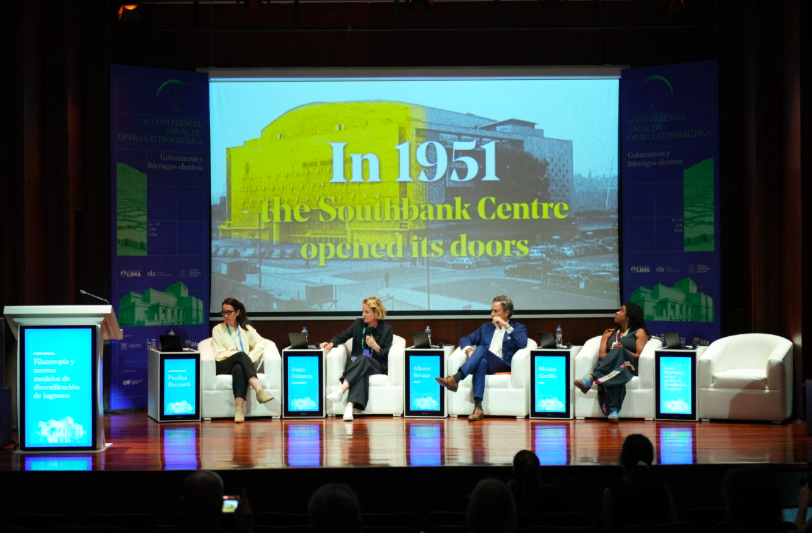
At the 19th Annual Ópera Latinoamérica Conference, experts debated about the future of cultural funding and the urgent need to adopt innovative business models to safeguard artistic independence. “The main challenge, then, is to stop assuming that generating revenue turns culture into a business,” reflects Paulina in her new opinion column.
By Paulina Ricciardi Mondino, Executive Director of Ópera Latinoamérica
“The performing arts have maintained the same level of productivity since the 18th century,” stated Guillermo Larraín at the 19th Annual Ópera Latinoamérica Conference in Lima. The Ninth Symphony or The Magic Flute take just as long to perform today as they did when they were created—the economist noted—and they cannot be shortened without altering the works themselves. Their costs, however, have risen, while public and private funding models are facing a crisis. Faced with this gap, the cultural sector can draw upon capabilities it knows well: the creation of meaning and creativity.
For decades, the sector relied on the belief that the intrinsic value of art was enough to secure support from the state or patrons. In a global landscape of budget cuts, that premise no longer suffices. Today, the value and driving force of culture are linked to a clear purpose: defining the value an organization brings to society and ensuring that this sense of purpose guides both artistic and budgetary decisions.
Given current challenges, diversifying revenue streams is essential to reducing organizations’ financial dependency. As long as these actions are driven by purpose, they will protect the institutions’ artistic independence and vision. The main challenge, then, is to stop assuming that generating revenue turns culture into a business.
In this line, creativity and innovation enable revenue diversification. Beyond sponsorships and ticket sales—among other strategies—cultural organizations today monetize their infrastructure through shops, restaurants, and venue rentals, or by selling productions and services. For instance, Gibney Dance rents studio space to Broadway companies, while the Cincinnati Symphony created a subsidiary to produce concerts and manage commercial spaces. London’s Southbank Centre is a prime example of this: opened in 1951 with state funding, it has always made cultural democracy a core objective of its operations. Over its 75-year history, however, its funding model has undergone a profound shift. As its Director of Operations, Susan Johnston, explained in Lima, public funding currently provides about 30% of its revenue, while its commercial arm contributes 45%—driven by hosting external events and operating restaurants and shops that attract millions of visitors.
This equation does not mean excluding the public sector, as the ultimate return on culture is social. Art and culture are rights, and the State must therefore guarantee access to and the development of them. Cultural organizations play a collaborative role in this endeavor; consequently, ensuring their sustainability is neither solely a private challenge nor exclusively a public obligation, but rather a partnership centered on a shared cause. The shift in perspective lies in recognizing that economic efficiency is not the enemy of culture, but a tool enabling it to continue enhancing the public’s quality of life.
Explore the magazine here: https://heyzine.com/flip-book/bc9078e0fb.html#page/11