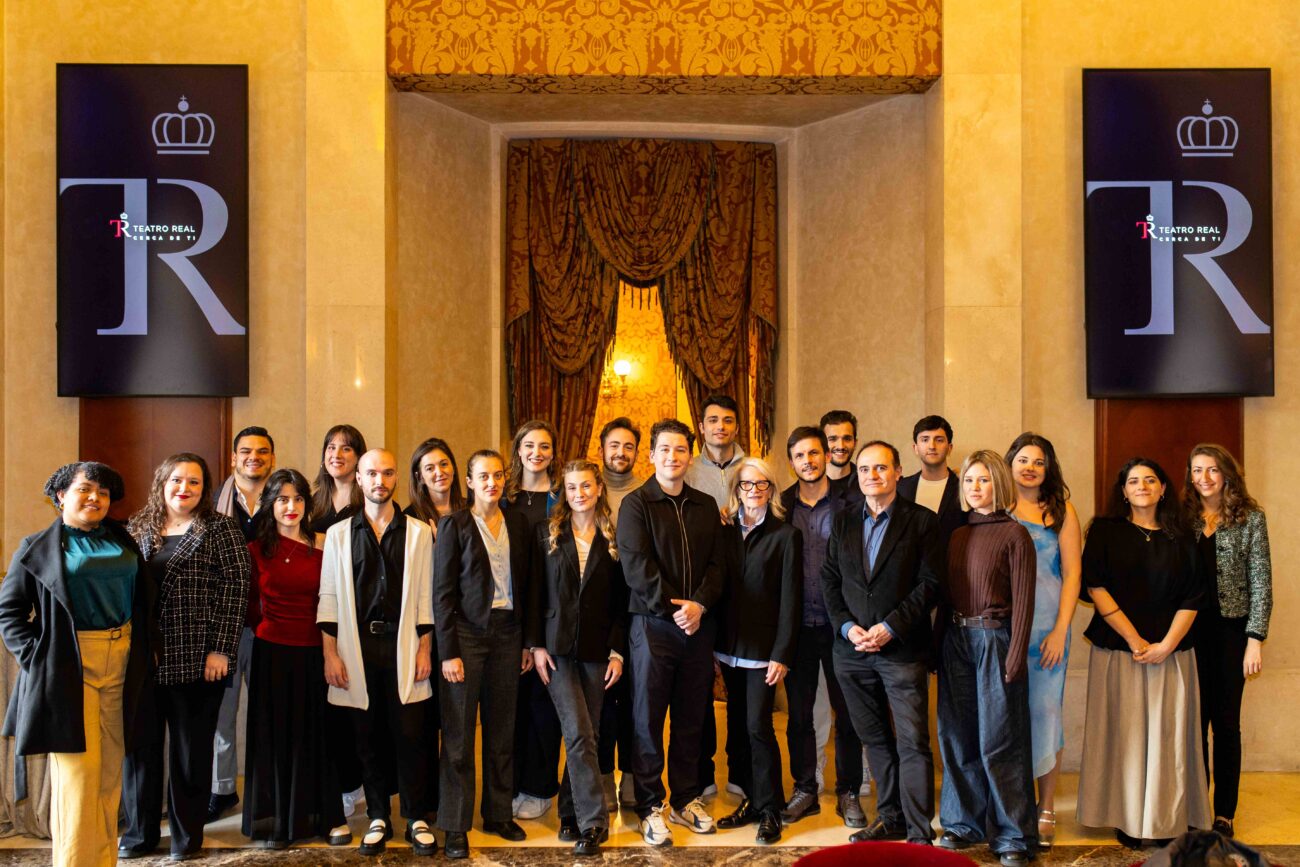

The National Opera Company premieres <<Rise and Fall of the City of Mahagonny in Mexico>>.

Rise and Fall of the City of Mahagonny is recognized as a fundamental work in the transformation of twentieth-century opera. The piece will be presented at the Palacio de Bellas Artes, a venue of the National Institute of Fine Arts and Literature (INBAL), an agency of the Ministry of Culture of the Government of Mexico. The monumental satire by Weill and Brecht will be performed on March 22, 24, 26, and 29, 2026.
The Ministry of Culture of the Government of Mexico and the National Institute of Fine Arts and Literature (INBAL), through the National Opera Company (CNO), will premiere Rise and Fall of the City of Mahagonny by Kurt Weill and Bertolt Brecht in Mexico at the Palacio de Bellas Artes (PBA), with a run from March 22 to 29, 2026.
At a press conference held in the Adamo Boari Hall of the PBA, Lilia Maldonado, Artistic Deputy Director of the CNO, expressed her enthusiasm about including Rise and Fall of the City of Mahagonny in the 2026 season: “It is a very important work for us because, although it was written in 1930, it addresses themes that are still very relevant today. It is a production that will move audiences deeply; it has been staged in an excellent way, and the singers who will participate are of a very high level.”

Accompanied by conductor Srba Dinić and stage director Marcelo Lombardero, Maldonado thanked the Palacio de Bellas Artes Choir and Orchestra, which she described as the heart of the National Opera Company (CNO), as well as the Embassy of Germany and the German Industry Cultural Trust for their collaboration in presenting the work in the country.
Rise and Fall of the City of Mahagonny, which has already premiered and received awards in Argentina, Chile, and Colombia, now arrives at the Main Hall of the Palacio de Bellas Artes, accompanied by the Bellas Artes Theatre Choir and Orchestra, with stage direction by Marcelo Lombardero, musical direction by Srba Dinić, and guest chorus direction by Luis Manuel Sánchez.

“Seeking to establish this small tradition—which we began last year—of premiering emblematic titles from the 20th and 21st centuries, this year we decided it was important to finally premiere this fundamental work of the dramatic operatic repertoire at the Palacio de Bellas Artes,” Lombardero said.
The creative team brings together outstanding stage artists: Diego Siliano, set design; Rafael Mendoza, lighting design; Luciana Gutman, costumes and makeup; Ignacio González Cano and Hugo Curcumelis, choreography; Giselle Huauscarriaga, video design; and Georg Tielmann, language coach.

The cast includes Rosa Muñoz as Leokadja Begbick; Evanivaldo Correa as Fatty, the Procurer; Hernán Iturralde as Moses Trinity; Hildelisa Hangis as Jenny; Gustavo López Manzitti as Jim Mahoney; Víctor Hernández as Jack; Alejandro Paz Lasso as Bill; David Echeverría as Joe—known as Joe, the Alaska Wolf; Luis Alberto Sánchez as Tobby Higgins; and pianist Andrés Sarre.
Also participating are twelve members of the women’s chorus: Edurne Goyarzu, Rosario Aguilar, Lucía Salas, Yutsil Romero, Diana Mata, Jazmín Quintero, Araceli Hernández, Sandra Olivas, Lourdes Beltrán, Belem Rodríguez, Guadalupe López, and Mariana Sofía García, along with four actors and ten dancers.
“Eighty percent of the cast is local—it is Mexican, it is from our own company—continuing this administration’s idea that we have enough artists to support any repertoire. We demonstrated this last year with two wonderful casts of Elektra, in which there were only three foreign artists,” Lombardero emphasized.
For his part, Srba Dinić said he was excited to work again with Lombardero and with the cast, as well as to be part of a production such as Rise and Fall of the City of Mahagonny: “It cannot be described so easily. Counting all the works I have conducted in my life, this is number 78, but I have never encountered one like this. It is very different from the ones I have done throughout my career.”

The City of Pleasure and the Law of Money
Divided into three acts, Rise and Fall of the City of Mahagonny tells the story of a fictional city founded in the middle of the desert under the promise of becoming a paradise of unlimited pleasure. Mahagonny is created as a place where everything seems possible—so long as one has money. In this environment of excess, violence, and increasing moral corruption, the city reaches its height of splendor while simultaneously sowing the seeds of its own destruction.
Written between 1927 and 1929, the work had its world premiere on March 9, 1930, at the Neues Theater in Leipzig, conducted by Gustav Brecher. Since then, it has been recognized as a fundamental work in the transformation of twentieth-century opera. With it, Kurt Weill and Bertolt Brecht consolidated one of the most significant collaborations in modern theatre, in a context marked by the social and political tensions of the Weimar Republic.
The score innovatively combines elements of traditional opera with jazz and popular song, incorporating rhythms and structures that were unconventional at the time and that challenged established forms while expanding the limits of the genre.
“The singers, the musicians, the conductor, and the stage director must move in a somewhat amphibious way, inhabiting two worlds: the formal world of academic, scholarly—often misnamed classical—music, and the world of popular music,” Lombardero explained about the complexity that makes the work unique.
He also recalled that the collaboration between Weill and Brecht shaped a model of musical theatre that broke with the romantic tradition of opera. Weill incorporated sounds close to jazz, popular song, and cabaret, while Brecht developed his concept of “epic theatre,” designed to encourage audiences to reflect rather than emotionally identify with the characters. The result is a sharp satire of capitalism, consumerism, and the loss of values—issues that still resonate with our reality today.
Season
Performances will take place on March 22, 24, 26, and 29, 2026—Tuesday and Thursday at 8:00 p.m., and Sunday at 5:00 p.m.—in the Main Hall of the Palacio de Bellas Artes. The approximate running time is 150 minutes, with a 15-minute intermission. The production is intended for audiences 16 years and older and will feature Spanish surtitles, as it will be performed in German.
Ticket prices are as follows:
Luneta 1: $1,000
Luneta 2: $800
Lower Amphitheater: $600
Upper Amphitheater: $400
Gallery: $150
Gallery with partial view: $90
A 50% discount will be offered to seniors, teachers, and students with valid ID.
For more information, consult the official social media accounts of the National Opera Company:
Facebook @operainbal, Instagram @operadebellasartes, X @OperaINBAL, and TikTok @operadebellasartes.